



Orthopedic Specialist Hip Implants
Orthopedic specialist hip implants are not only devices. They are the core of a predictable arthroplasty pathway that survives busy lists and rotating staff. When the method is clear from planning to early mobilization, day one quality looks like day thirty quality. Administrators gain the confidence to allocate theatres and protect schedules.
Committees assess more than metallurgy and geometry. They ask whether a vendor can keep timelines, publish simple instructions for use, and teach a verification rhythm that any trained professional can follow. A disciplined program for Orthopedic Specialist Hip Implants lowers variance in theatres. Patient journeys become steadier and safer.
Nursing leaders and CSSD managers judge the everyday friction. They want trays that mirror the clinical sequence, labels that scan without confusion, and maintenance windows that are booked in advance. When the implant story aligns with these operational truths, lists start on time and finish on time. That is the metric a hospital remembers.
Distributors need a method they can defend with numbers. Honest lead times, public reorder rules, and bilingual documentation allow partners in South Africa, Morocco, Algeria, Egypt, Nigeria, Ghana, Kenya, Tanzania, Libya, Gabon, Senegal, Namibia, Cameroon, Guinea, DRC, and Côte d’Ivoire to run stable programs. Orthopedic specialist hip implants perform best when every link is visible and owned.
What Ortonom Medical provides to orthopedic specialists
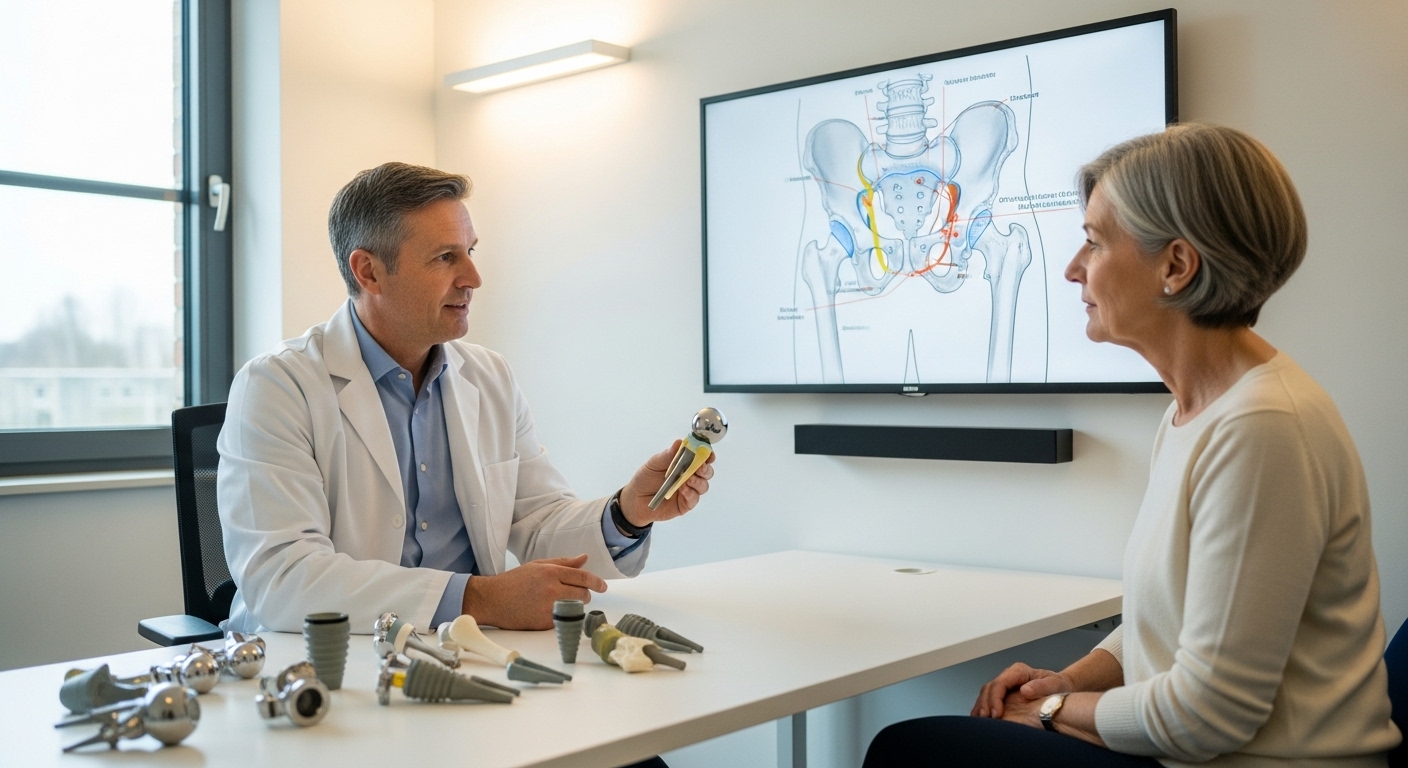
Ortonom Medical designs hip families that help experts teach alignment, stability, and restoration of biomechanics with less cognitive load. Cementless primary stems and cups use surface technology and geometry that support axial and rotational stability while preserving bone when possible. Cemented stems are available for mixed bone quality with clear cement discipline guidance. Bipolar partial heads support fracture care and geriatric pathways.
Instrumentation follows the clinical sequence, not a catalog order. Canal entry, broach progression, trial reduction, and final seating appear on the tray in the order the team will use them. Handles are glove friendly and markings remain legible in theatre lighting. The tray tells the same story as the IFU and the training clips, which shortens learning curves.
Documentation is treated as a clinical tool. Technical files trace inputs through verification and validation to labeling and shelf life. IFU are bilingual in English and French with QR links to concise videos that staff can watch between cases. Labels scan cleanly into UDI systems so perioperative teams spend time on patients, not on paperwork.
Training is modular and reusable. Micro lessons focus on a single checkpoint such as cup orientation, femoral version control, taper hygiene, offset reconciliation, or reduction stability. Pocket cards and a one page spec snapshot use the same words as the tray and IFU. Orthopedic Specialist Hip Implants then become a method that a whole room can repeat.
Surgical method for Orthopedic Specialist Hip Implants
Preparation begins before incision. A five minute briefing aligns surgeon, scrub, anesthesia, and CSSD on tray layout, verification points, fluoroscopy plans, and early mobilization policy. The team confirms the target leg length, offset, and version strategy. A shared mental model prevents small misunderstandings from becoming late delays.
Acetabular preparation emphasizes controlled reaming and visible orientation cues. The surgeon verifies inclination and anteversion against the plan. A deliberate press fit check confirms seating and stability. Liner selection follows reduction goals, not habit. This simple loop protects both stability and range.
Femoral preparation stresses canal entry, broach progression, and a quiet moment at trial reduction to reconcile offset and length with the plan. The team speaks findings aloud. If stability is marginal, the plan adjusts before final seating. Views of the taper remain clear during impaction, which protects interface integrity.

Closure and early mobilization protocols use the same language as the IFU and quick cards. When bedside explanations mirror theatre steps, families feel informed and handovers stay smooth. Surgical steps then become hospital language. Orthopedic Specialist Hip Implants turn into culture rather than event.
Documentation and compliance that pass on first submission
Committees approve the clearest story. Ortonom Medical prepares conservative technical files for each family of Orthopedic Specialist Hip Implants. Specifications, risk management, verification and validation, labeling, UDI schema, and shelf life appear in a uniform template. Reviewers do not need to relearn structure.
IFU mirror the tray sequence and mark the same verification checkpoints used in training. QR links open short clips that teams can watch between cases. Tray checklists are written for CSSD adoption, which reduces rebuilds and lost pieces. Version controlled masters and named regulatory contacts keep documents current as protocols evolve.
Country copy is localized without changing the method. English and French are standard. Arabic summaries are available where they help logistics or patient education. Customs and audits become routine rather than emergencies. Timelines hold because paperwork reads like the theatre sequence.
When documents pass at first submission, budgets hold as well. This is how compliance discipline connects to commercial predictability. Orthopedic Specialist Hip Implants benefit because the pathway is not interrupted by surprises on paper.
Inventory and logistics that keep theatres on time
Fast movers stay in country. Central stem sizes, common head diameters, and the middle range of cup diameters live near theatres. Long tail references rotate from regional hubs to preserve cash while maintaining availability. Reorder points use observed usage rather than optimistic forecasts. Requests then match reality.
Instrument turnaround removes more stress than most expect. CSSD aligned checklists and planned maintenance windows keep trays returning on time. A visible board shows set status and cases covered for the next days. When tomorrow’s sets are ready today, lists start on time and finish on time.
If customs or transport slow a lane, communication is early and concrete. A workable workaround beats a vague promise that shifts pressure downstream. Under promise and over deliver remains a classic principle that builds trust in both public and private networks across Africa.
Consignment is a behavior agreement as much as a stock decision. The hospital commits to monthly reporting and Ortonom Medical commits to published reorder rules. Shelf age is reviewed and the long tail rotates. Predictable movement protects budgets and reputations for everyone involved with Orthopedic Specialist Hip Implants.
Ninety day launch plan
A conservative timeline keeps promises credible. The plan below is the baseline used by Ortonom Medical for Orthopedic Specialist Hip Implants across Africa.
Four priorities guide the first month. The team finalizes bilingual decks and IFU, confirms the regulatory pack, builds a starter stock matrix that matches the first sites, and reserves theatre time for supervised cases. A one page readiness audit closes gaps before launch.
The second month focuses on training and first cases. Workshops serve surgeons, scrub nurses, and CSSD. Micro lessons repeat the same verification rhythm. The first cases run under supervision. Findings are captured in a short note after each list.
The third month executes and tunes. Ten to twelve cases per site establish cadence. Insert and head distribution are adjusted to usage. CSSD maintenance windows are aligned with the weekly schedule. A brief outcomes summary is shared with hospital leadership.
Scaling begins when repeatability is visible. A second site in the same country strengthens references. The same documents and trays then travel to the next market without change. Orthopedic Specialist Hip Implants scale quietly because the artifacts remain constant.
| Phase | Focus | What happens | Outcome |
|---|---|---|---|
| Weeks 1 to 3 | Prepare | Finalize decks and IFU. Confirm regulatory pack. Build stock matrix. Reserve theatre slots. | Paperwork ready and story clear |
| Weeks 4 to 6 | Train | Workshops and first supervised cases. Emphasis on verification rhythm. | Calm execution under supervision |
| Weeks 7 to 10 | Execute | Ten to twelve cases per site. Debriefs each list. Tune head and liner distribution. Align CSSD maintenance. | Stable cadence and honest stock |
| Weeks 11 to 13 | Scale | Add one hospital. Publish outcomes summary and short change log. Approach frameworks with references. | Repeatability and references |
Product and instrument snapshot for committees
Four product families cover primary and partial pathways. A single documentation style and shared instrumental language shorten onboarding. Orthopedic Specialist Hip Implants feel familiar even when indications differ.

The clinical core for cementless primary total hip arthroplasty focuses on cup orientation and femoral version control. Cemented stem pathways emphasize cement discipline and liner seating. Bipolar partial hip supports fracture care with attention to reduction stability and early mobilization. A modular revision bridge outlines rules for early conversion when needed.
A short training plan accompanies each family. It uses the same four checks that teams repeat until they become reflex. The tray layout, the IFU, and the pocket card match. This consistency is the reason a method survives staff rotation.
| Family | System | Core use | Training focus |
|---|---|---|---|
| OrtoHip Cementless Primary | Press fit stem and cup | Degenerative hips in high throughput centers | Cup inclination and anteversion, femoral version, offset and length reconciliation |
| OrtoHip Cemented Stem Pathway | Cemented stem with press fit cup | Mixed bone quality contexts | Cement discipline on stem, liner seating, reduction checks |
| OrtoHip Bipolar Partial | Bipolar head with compatible stems | Fracture and geriatric trauma | Head selection, reduction stability, early mobilization routine |
| OrtoHip Modular Revision Bridge | Early conversion rules | Complex primaries that may convert | Explant tools and augmentation planning overview |
Starter stock matrix and reorder logic
The figures below are illustrative. They show structure rather than a quote. They help committees connect clinical scope to inventory behavior.
Four reference bands usually cover most cases. The middle sizes are local fast movers. The extremes rotate from hub. Reorder points are public. Everyone sees the rule that triggers a shipment. Orthopedic Specialist Hip Implants remain dependable because expectations are realistic.
A simple monthly review adjusts points to usage. Shelf age is checked. Slow references move. The logic protects cash and keeps rooms ready.
| Component group | Starter range | Local fast movers | From hub | Reorder rule |
|---|---|---|---|---|
| Stems | Sizes 3 to 9 | 4 to 7 | 3, 8, 9 | Reorder when 2 remain per size |
| Cups | Diameters 48 to 60 | 50 to 56 | 48, 58, 60 | Reorder when any size hits 2 |
| Heads | Ø 28 to 36 with common necks | 32 most offsets | 28 and 36 extremes | Reorder when any offset hits 3 |
| Liners | Standard and high wall | Standard first | High wall as needed | Reorder when any model hits 3 |
RACI roles and responsibilities
Clear roles prevent disappointment and speed decisions. The matrix below is typical for first quarter operations. It is published at launch and reviewed at day thirty and day ninety.
The regulatory lead at the distributor files the country pack and coordinates with the hospital committee secretary. Ortonom Medical’s regulatory manager owns the master documents. The clinical team at Ortonom runs workshops and supports first cases. CSSD manages instrument maintenance with a plan aligned to theatre schedules.
Procurement and finance own consignment rules and reporting. Hospital clinical champions publish a short outcomes note that the committee can read in one sitting. Orthopedic Specialist Hip Implants win meetings when roles are simple and visible.
| Item | Responsible | Accountable | Consulted | Informed |
|---|---|---|---|---|
| Regulatory dossier filing | Distributor regulatory lead | Ortonom regulatory manager | Hospital committee secretary | Hospital admin |
| Training workshops | Ortonom clinical team | Head of department | CSSD lead and nursing educator | Procurement |
| Instrument maintenance plan | CSSD manager | Hospital biomedical lead | Ortonom service coordinator | Theatre scheduler |
| Consignment and reorder rules | Distributor operations lead | Distributor GM | Hospital procurement | Finance |
| Outcomes summary note | Hospital clinical champion | Head of department | Ortonom clinical team | Committee |
Country focus across Africa and partner profile
South Africa rewards programs that respect audit culture. A lighthouse site in Gauteng followed by a secondary site in Western Cape demonstrates repeatability. References open doors to frameworks and group purchasing. Orthopedic Specialist Hip Implants fit because verification steps are measurable and documentation is tidy.
Egypt blends large public tenders with fast private groups. Bilingual packs and prudent lead times are decisive. Early CSSD involvement prevents tray rebuilds and protects cadence. Morocco and Algeria benefit from the same assets, with French copy and Arabic summaries that reduce coordination friction.

Nigeria and Ghana value vendors who publish their method and keep it. Showing reorder points and the latest adjustments builds confidence. Kenya and Tanzania respond well to on site teaching for first cases and simple consignment for fast movers. Libya and Gabon appreciate named contacts and clear maintenance windows. In DRC, Senegal, Namibia, Cameroon, Guinea, and Côte d’Ivoire, programs often start with a single anchor site, then scale with the same documents and trays.
A strong partner profile is consistent across countries. Respect hospital routines. Communicate early about logistics. Run clean committee packs. Ortonom Medical supports that profile with training, dossiers, and stock logic that anyone can inspect. Orthopedic Specialist Hip Implants then feel like a dependable service rather than a shipment.
Closing invitation
If you bring hospital access, field discipline, and a service first culture, Ortonom Medical will bring a coherent program for Orthopedic Specialist Hip Implants that is easy to teach, simple to audit, and steady to run. Schedule the first workshop, set the first supervised cases, and publish a short outcomes note. That is how we convert intention into a reliable pathway across Africa, one quiet list at a time.
 Ortonomy refers to the study and application of principles related to the proper function and structure of systems, especially in biological or technological contexts. In medical terms, it often refers to the alignment and balance of body structures.