



Orthopedic Implant Supplier for Hospitals
Orthopedic implant supplier for hospitals is a high value search intent for procurement teams, orthopedic departments, purchasing committees, hospital executives, and healthcare groups that need reliable hip and knee arthroplasty solutions. Hospitals do not evaluate orthopedic implants only as individual products. They evaluate supplier reliability, stock continuity, instrument readiness, documentation, traceability, and long term cooperation capacity.
Orthopedic implant supplier for hospitals should be understood as a strategic partnership category. In hip and knee replacement surgery, the supplier must support clinical workflows and purchasing requirements at the same time. The right implant system must be available, the correct instruments must be prepared, the documentation must be usable, and the supply model must protect planned surgical activity.
Ortonom Medical focuses on hip and knee arthroplasty systems for hospitals, orthopedic specialists, healthcare organizations, and distribution partners. The company’s portfolio includes OrtoHip Bipolar Hip System, OrtoHip K2 Revision Hip System, OrtoHip Total Hip System, OrtoKnee Fixed Knee System, OrtoKnee Revision Knee System, and OrtoKnee Mobile Knee System. This focused product range allows hospitals to evaluate Ortonom Medical as a specialized orthopedic implant partner rather than a broad and unrelated medical equipment supplier.
Why hospitals need specialized orthopedic implant suppliers
Hospitals require more than product availability when they choose an orthopedic implant supplier. Hip and knee arthroplasty programs depend on consistent system access, compatible instruments, clear usage records, and coordination between surgical, purchasing, and sterile services teams. A supplier that cannot support these areas may create operational pressure even if the product itself is available.
A specialized orthopedic implant supplier understands that hospital procurement is not a single step transaction. It includes clinical evaluation, purchasing approval, operating room readiness, inventory planning, traceability, and periodic performance review. Each department needs clear information before the hospital can build trust in a supplier relationship.
For this reason, hospitals should evaluate suppliers according to their ability to support complete arthroplasty programs. Ortonom Medical’s focus on hip and knee implant systems makes the supplier conversation more direct, more relevant, and more practical for hospital decision makers.
From product supply to hospital arthroplasty partnership
A one time order may solve an urgent implant need, but it does not create a stable hospital program. Hospitals that perform hip and knee replacement procedures need a supplier relationship that can support repeated use, predictable availability, and long term planning.
An orthopedic implant partnership begins with product clarity. The hospital should understand which systems are included, which surgical pathways they support, which instruments are required, and which sizes should be planned as core stock. Without this clarity, purchasing teams may approve products without understanding how they will function in daily hospital operations.
Ortonom Medical can support hospitals by presenting hip and knee implant systems within a structured cooperation model. This helps procurement teams, surgeons, operating theatre teams, and sterile services teams align around one shared framework.
| Hospital need | Why it matters | Supplier role |
|---|---|---|
| Product clarity | Prevents confusion during evaluation | Present focused hip and knee systems |
| Stock continuity | Protects scheduled surgery lists | Plan core sizes and replenishment |
| Instrument readiness | Supports operating room preparation | Define tray and instrument workflows |
| Documentation | Supports governance and patient records | Provide usable traceability processes |
| Long term cooperation | Reduces repeated purchasing uncertainty | Build structured hospital agreements |
What procurement teams should evaluate before supplier approval
Hospital procurement teams should not approve orthopedic implant suppliers only by comparing unit prices. Price is important, but hip and knee arthroplasty requires broader value analysis. A lower cost may not protect the hospital if stock gaps, incomplete instruments, weak documentation, or delayed replenishment create operational problems.
The first evaluation point is specialization. Procurement teams should ask whether the supplier is focused on orthopedic implant systems or whether implants are only a small part of a broad medical equipment catalog. A focused supplier can usually provide a more relevant discussion about product pathways, instrument requirements, and surgical support.

The second evaluation point is continuity. The hospital must understand how products will remain available after approval. This includes stock levels, replenishment timing, urgent access planning, and communication routines. These details help the hospital avoid last minute pressure before scheduled surgeries.
Important procurement questions include:
- Which hip and knee implant systems are included in the proposal
- Which procedures each implant system is intended to support
- Which sizes should be kept as core stock
- Which instruments and trays are required
- How lot information and traceability will be recorded
- How replenishment will be managed after usage
- How urgent requirements will be escalated
- How supplier performance will be reviewed over time
Hip implant systems for hospital orthopedic programs
Hip implant systems are a central part of hospital arthroplasty programs. A hospital evaluating an orthopedic implant supplier for hospitals must review the hip portfolio according to clinical pathway, component availability, instrument compatibility, and documentation requirements.
Ortonom Medical’s hip portfolio includes OrtoHip Bipolar Hip System, OrtoHip K2 Revision Hip System, and OrtoHip Total Hip System. These systems support different hospital needs within hip arthroplasty while remaining inside a focused supplier relationship.
OrtoHip Bipolar Hip System can support hospitals that require a defined bipolar hip pathway. OrtoHip Total Hip System is relevant for total hip replacement programs where acetabular components, femoral components, trials, and instruments must be coordinated. OrtoHip K2 Revision Hip System supports hospitals preparing for revision hip procedures and more complex arthroplasty planning.
Ortonom Medical hip portfolio
- OrtoHip Bipolar Hip System
- OrtoHip K2 Revision Hip System
- OrtoHip Total Hip System
For hospitals, this portfolio helps simplify purchasing and clinical evaluation. Instead of reviewing disconnected hip components from multiple sources, the hospital can discuss a structured hip pathway with stock planning, instrument readiness, and long term support.
Knee implant systems for hospital purchasing teams
Knee implant systems also require careful purchasing evaluation. Hospitals need to know whether the supplier can support primary knee replacement, mobile bearing pathways, revision needs, instrument preparation, and long term replenishment.
Ortonom Medical’s knee portfolio includes OrtoKnee Fixed Knee System, OrtoKnee Revision Knee System, and OrtoKnee Mobile Knee System. This product range helps hospitals evaluate fixed, mobile, and revision knee solutions under one focused orthopedic implant portfolio.
OrtoKnee Fixed Knee System can support structured primary knee replacement programs. OrtoKnee Mobile Knee System gives hospitals another pathway for knee arthroplasty planning. OrtoKnee Revision Knee System is important for hospitals that want to prepare for more complex knee cases and revision capability.
Ortonom Medical knee portfolio
- OrtoKnee Fixed Knee System
- OrtoKnee Revision Knee System
- OrtoKnee Mobile Knee System
For purchasing teams, the value of these knee systems increases when they are supported by clear documentation, predictable supply, compatible instruments, and a supplier relationship that can be measured over time.
Stock continuity and replenishment planning
Stock continuity is one of the strongest reasons hospitals need a reliable orthopedic implant supplier. Hip and knee replacement procedures can be affected if the correct size, trial component, or instrument set is unavailable when the case is scheduled.
A strong replenishment model should begin with expected case volume. The hospital and supplier should define which implant sizes are most likely to be used, which systems require core stock, and how quickly products should be replenished after use.
Ortonom Medical can support hospital conversations by connecting product selection with stock planning. This allows the hospital to move from reactive purchasing to a more predictable supply model.
| Stock planning element | Hospital objective | Supplier support |
|---|---|---|
| Core size planning | Keep essential sizes available | Define minimum availability levels |
| Usage tracking | Understand product movement | Record use after procedures |
| Replenishment routine | Avoid repeated shortages | Plan reorder process |
| Urgent pathway | Manage unexpected needs | Define escalation contacts |
| Periodic review | Improve planning accuracy | Review stock and usage patterns |
Instrument readiness before surgery
In hip and knee arthroplasty, instruments are not secondary items. They are part of the complete surgical pathway. A hospital may have the implant in stock, but surgery can still be disrupted if the necessary instruments are incomplete, unavailable, damaged, or not prepared correctly.
Hospitals should evaluate instrument readiness before approving a supplier. This includes tray content, inspection routines, missing item reporting, sterile services preparation, and communication between the supplier and hospital teams.
For Ortonom Medical systems, instrument readiness should be discussed together with product selection. The OrtoHip and OrtoKnee systems require a clear operational plan so that surgeons, operating theatre teams, and sterile services teams can work with confidence.
Documentation and traceability for hospital governance
Documentation is a critical part of orthopedic implant supply. Hospitals need accurate product references, lot information, usage records, and traceability routines. These details support patient records, inventory control, internal audits, and procurement accountability.
Weak documentation can create problems even when products are delivered on time. If usage records are unclear, procurement teams may struggle to manage replenishment. If traceability is incomplete, hospital governance may be affected. If product references are inconsistent, clinical and purchasing teams may face confusion.
A strong orthopedic implant supplier for hospitals should make documentation practical and repeatable. Ortonom Medical’s systems should be presented with clear product data, traceability processes, and usage documentation that support daily hospital operations.
Why purchasing committees should look beyond unit price
Unit price is only one part of supplier evaluation. Hospitals also need to consider the total operational value of a supplier relationship. A product with a lower upfront price can become costly if it creates delays, urgent stock issues, documentation gaps, or repeated coordination problems.
Purchasing committees should evaluate whether the supplier can support a complete hip and knee replacement program. This includes products, instruments, documentation, training support, stock planning, and communication routines.
Ortonom Medical can be positioned as a focused partner for hospitals that want more than isolated implant purchases. The goal is to support a dependable arthroplasty supply model where clinical and purchasing teams can operate with greater confidence.
Hospital agreements for long term orthopedic supply
Long term hospital agreements can make orthopedic implant supply more stable. Instead of placing repeated separate orders, hospitals can define product scope, expected volume, core stock, instrument responsibilities, documentation rules, and review schedules.
This type of agreement helps multiple departments. Procurement teams gain better visibility. Surgeons gain confidence in product and instrument readiness. Sterile services teams understand preparation routines. Hospital management can evaluate supplier performance more clearly.
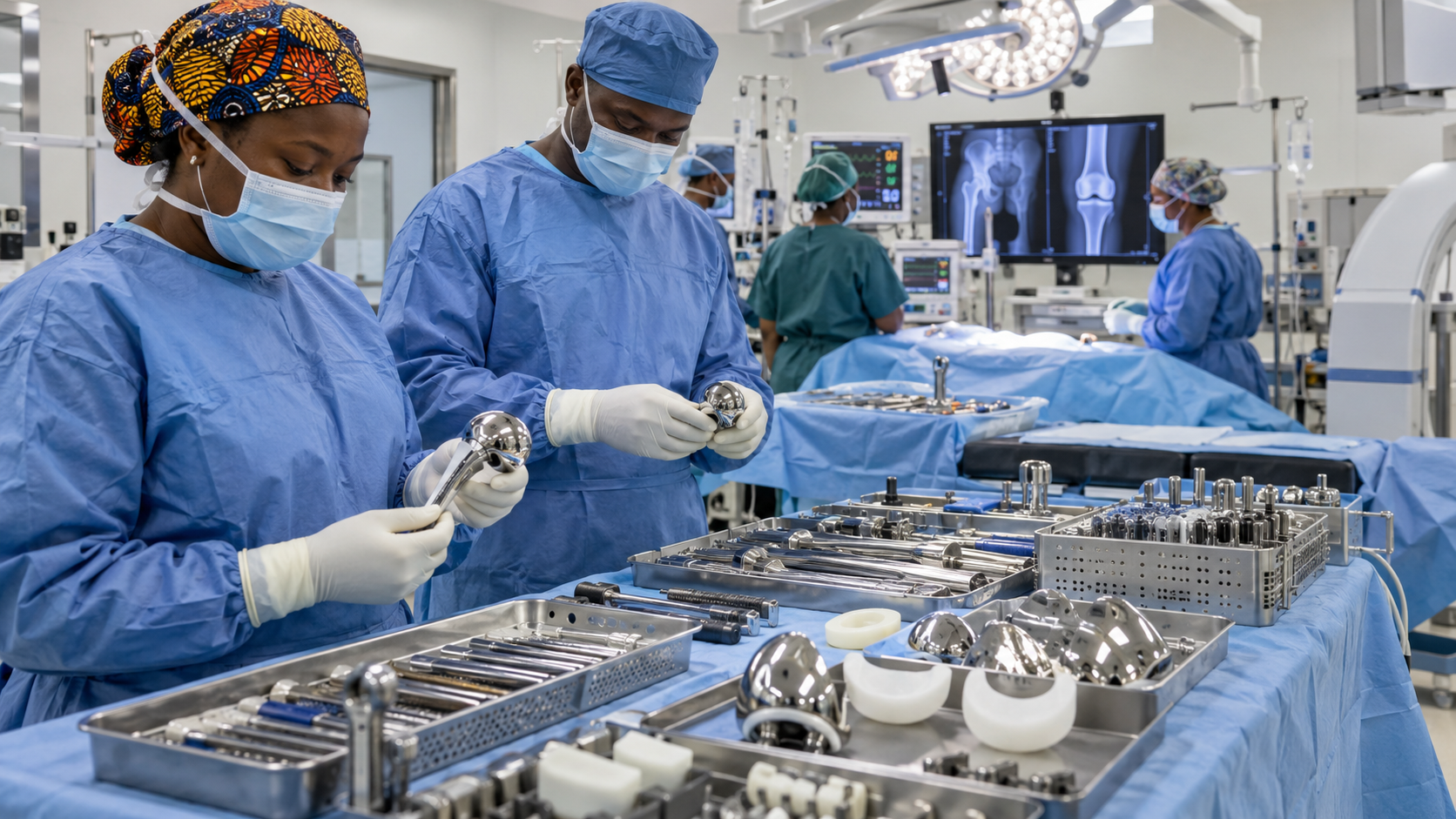
For Ortonom Medical, hospital agreements are an opportunity to build structured cooperation around hip and knee arthroplasty. The purpose is not only to deliver implants, but to support hospital continuity and reliable surgical planning.
Key agreement elements may include:
- Selected OrtoHip and OrtoKnee systems
- Expected hip and knee procedure volume
- Core stock and replenishment rules
- Instrument tray responsibilities
- Documentation and traceability processes
- Training and communication routines
- Periodic performance review
Orthopedic implant supplier for hospitals in Africa
Hospitals across Africa are increasingly evaluating suppliers according to stability, specialization, and program support. This is especially important in markets such as Egypt, Algeria, Morocco, Nigeria, Ghana, Kenya, Tanzania, South Africa, Libya, Senegal, Cameroon, Gabon, Namibia, Guinea, DRC, and Côte d’Ivoire.
For these healthcare environments, the supplier decision must go beyond basic product availability. Hospitals need orthopedic implant systems that can support operating room readiness, stock continuity, documentation, traceability, and long term cooperation.
Ortonom Medical can support hospitals, orthopedic departments, private healthcare groups, procurement teams, and distribution partners that need focused hip and knee implant systems rather than unrelated general medical equipment categories.
How this keyword supports B2B hospital leads
The keyword orthopedic implant supplier for hospitals has strong B2B value because it speaks directly to institutional decision makers. A hospital buyer using this type of search is likely evaluating supplier suitability, product scope, cooperation potential, and purchasing reliability.
This topic also supports related internal linking opportunities. It can connect naturally with medical equipments for hospitals, orthopedic medical equipments for hospitals, hospital procurement for orthopedic implants, hip implant supplier, knee implant supplier, arthroplasty implants, and hip and knee prosthesis articles.
For Ortonom Medical, the keyword helps move broad medical equipment traffic toward a more qualified orthopedic implant audience. Visitors looking for unrelated medical products can understand the company’s scope quickly, while hospitals looking for hip and knee implant systems can continue toward a relevant inquiry.
Why hospitals can consider Ortonom Medical
Hospitals evaluating orthopedic implant suppliers need clarity, focus, and long term reliability. Ortonom Medical offers a product portfolio centered on hip and knee arthroplasty rather than a broad catalog of unrelated medical equipment.
The OrtoHip portfolio supports bipolar, total hip, and revision hip pathways. The OrtoKnee portfolio supports fixed, mobile, and revision knee pathways. Together, these systems provide hospitals with a structured product base for orthopedic program planning.
For procurement teams, orthopedic surgeons, and healthcare organizations, the value of Ortonom Medical is based on product clarity, supply continuity, instrument readiness, documentation, traceability, and long term cooperation. These factors are essential for hospitals that want to build reliable hip and knee replacement programs.
Orthopedic implant supplier for hospitals is an important topic for procurement teams, purchasing committees, orthopedic departments, hospital executives, and healthcare organizations searching for reliable hip and knee arthroplasty cooperation. The supplier decision should not be based only on implant availability or unit price. It should include surgical readiness, stock continuity, documentation, traceability, and long term hospital support.
Ortonom Medical supports hospitals with OrtoHip Bipolar Hip System, OrtoHip K2 Revision Hip System, OrtoHip Total Hip System, OrtoKnee Fixed Knee System, OrtoKnee Revision Knee System, and OrtoKnee Mobile Knee System.
For hospitals and healthcare groups, Ortonom Medical offers a focused pathway from orthopedic implant supplier search intent to structured hip and knee arthroplasty cooperation. The objective is to support purchasing confidence, protect surgical continuity, and strengthen long term hospital supplier relationships.