



Knee Arthroplasty Manufacturers
Knee arthroplasty manufacturers are not evaluated in Africa on claims alone. They are evaluated on whether hospitals can run a dependable knee program that starts on time, keeps core sizes available, and avoids last minute substitutions that damage theatre efficiency. When a hospital is considering an agreement, the manufacturer’s real value shows up in operational stability, not in a brochure.
Knee arthroplasty manufacturers also compete on how well they support adoption across different teams. In many African hospitals, staffing rotates, case volume fluctuates, and the OR must move fast. If instrument readiness is inconsistent or replenishment is unpredictable, the program becomes fragile and surgeon confidence drops quickly. Hospitals want partners that help reduce variability, not add to it.
Ortonom Medical is a hip and knee implant manufacturer focused on arthroplasty programs for African hospitals. This article stays strictly within that scope and focuses on how hospital agreements are won through program readiness, portfolio clarity, and repeatable implementation.
From evaluation to agreement what hospitals actually sign for
Hospitals do not sign for “implants” in isolation. They sign for a supply and support system that protects the theatre schedule and the patient pathway. The agreement conversation usually includes availability rules, replenishment cadence, traceability routines, and an escalation path that works when an urgent need appears.
A strong agreement is built around predictable routines. Hospitals want to know which sizes will always be available, how replenishment is triggered, and what happens when a case needs an unexpected option. If these points are not defined, procurement hesitates because the program risk looks uncontrolled.
Hospital groups and multi site organizations add another layer. They want standardization across facilities, with the same rules applied in each site. This is a major advantage for a manufacturer that can present a repeatable agreement structure that works across different hospitals without creating exceptions every week.
Country hub strategy for African hospital partnerships
African hospital partnerships perform better when country focus is explicit. Hospitals search and evaluate partners with local realities in mind, including logistics routes, procurement habits, and private healthcare concentration. For SEO and for commercial outreach, it helps to address the target markets directly and consistently.
Ortonom Medical’s target markets include South Africa Gauteng, Morocco, Algeria, Egypt, Nigeria, Ghana, Kenya, Tanzania, Libya, Gabon, Senegal, Namibia, Cameroon, Guinea, DRC, and Côte d’Ivoire. These markets contain high value hubs, growth corridors, and multi site networks where stable arthroplasty delivery is a competitive advantage.
A practical way to keep country specificity meaningful is to connect each country to what hospitals care about most. In South Africa Gauteng and Namibia, theatre utilization and schedule protection tend to be highly visible. In Morocco, Algeria, Egypt, and Libya, governance discipline and auditable routines are often emphasized. In Nigeria, Ghana, Senegal, Côte d’Ivoire, and Guinea, scalable availability and consistent support often decide whether programs grow smoothly. In Kenya, Tanzania, Cameroon, DRC, and Gabon, readiness and predictable execution can be the differentiator that builds long term trust.
| Region hub | Target markets | What hospitals prioritize | What a manufacturer must prove |
|---|---|---|---|
| Southern Africa | South Africa Gauteng, Namibia | Schedule protection and responsiveness | Core sizes available and fast escalation |
| North Africa | Morocco, Algeria, Egypt, Libya | Governance and standardization | Auditable routines and stable replenishment |
| West Africa | Nigeria, Ghana, Senegal, Côte d’Ivoire, Guinea | Scaling programs without chaos | Repeatable model across sites |
| East Africa | Kenya, Tanzania | Readiness while volumes grow | Simple routines that teams can run |
| Central Africa | Cameroon, DRC, Gabon | Consistent execution under constraints | Predictable support and continuity |
What makes a knee program stable in the OR
Hospitals do not experience knee arthroplasty as a product category. They experience it as a weekly operating rhythm. When the rhythm breaks, it usually breaks in the same places: missing core sizes, incomplete trays, inconsistent reprocessing, or unclear verification routines between teams.
Stability starts with defining a core set. A core set is not “everything.” It is the high runner sizes and components that protect planned cases. When the core set is defined, the hospital can standardize reorder points and replenishment cadence. This reduces emergency procurement and makes theatre planning more predictable.
Stability also depends on controlling variability across teams. Knee arthroplasty is sensitive to small workflow inconsistencies. When a manufacturer supports clear routines and predictable instrument flow, surgeons can focus on technique rather than troubleshooting. That is exactly what hospitals in Egypt, Morocco, Algeria, Nigeria, and South Africa Gauteng value when choosing a long term partner.
Portfolio clarity that supports both primary and revision pathways
Hospitals prefer knee arthroplasty manufacturers that support continuity. They do not want to switch vendors when case complexity changes. They also want a platform that fits into a broader joint program, because hip and knee services often grow together in premium African hospitals.
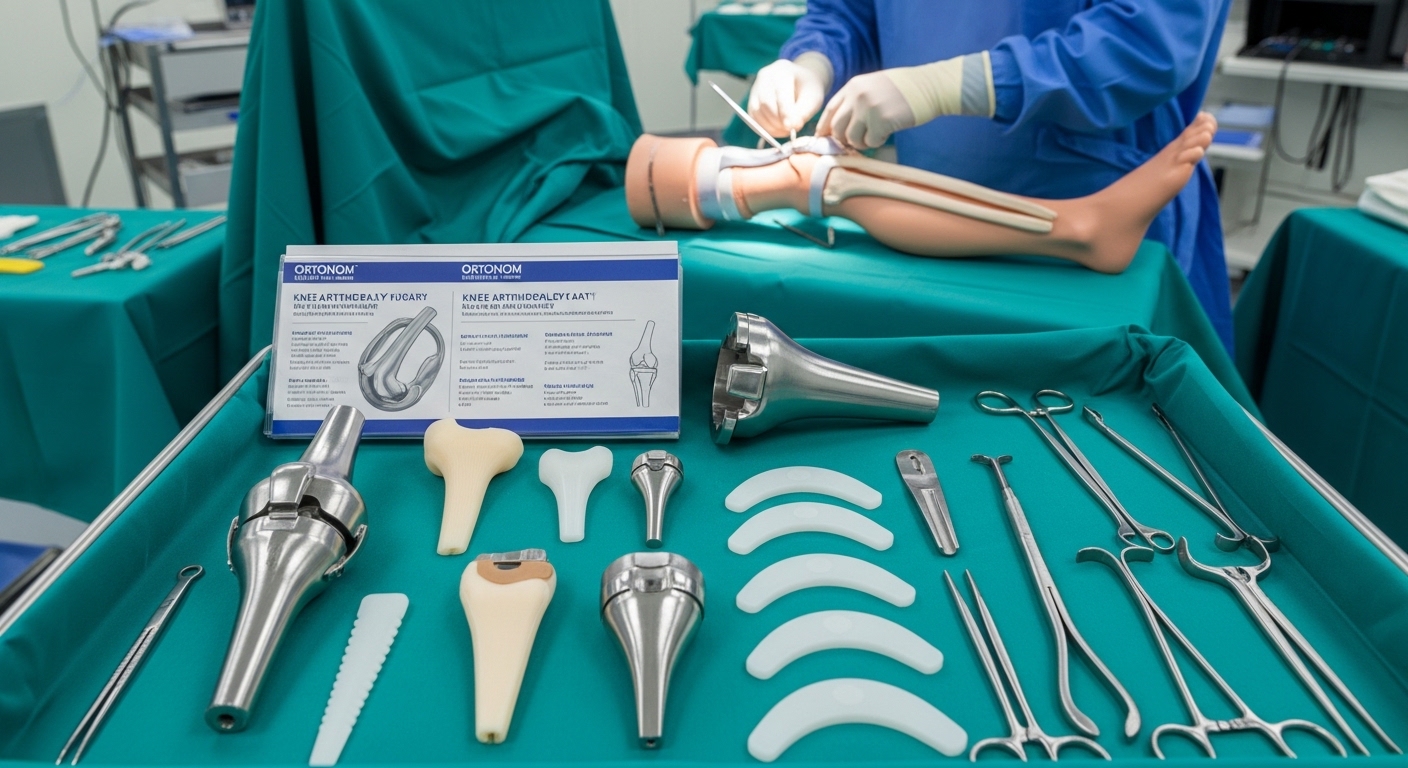
Ortonom Medical’s knee portfolio includes OrtoKnee Fixed Knee System, OrtoKnee Mobile Knee System, and OrtoKnee Revision Knee System. This structure supports primary knee programs while maintaining a credible path when revision capability becomes important. Hospitals in Kenya, Tanzania, and Ghana often value this continuity because it reduces vendor fragmentation as programs expand.
Ortonom Medical also maintains a hip portfolio that supports the same program approach and strengthens partnership discussions with hospital groups. The hip range includes OrtoHip Bipolar Hip System, OrtoHip Total Hip System, and OrtoHip K2 Revision Hip System. In markets like South Africa Gauteng, Egypt, Morocco, and Nigeria, broader program alignment can strengthen the case for a long term agreement.
- OrtoKnee Fixed Knee System
- OrtoKnee Mobile Knee System
- OrtoKnee Revision Knee System
- OrtoHip Bipolar Hip System
- OrtoHip Total Hip System
- OrtoHip K2 Revision Hip System
Operational model hospitals accept in agreements
Hospitals want a model that is simple enough to run daily and strict enough to audit. If the model is too complex, it collapses in practice. If it is too vague, it becomes risky. The best agreements define routines for stock, tray readiness, usage capture, and escalation, and then keep those routines consistent.

A strong agreement typically defines core size minimums, reorder points, and replenishment cadence. It also defines who owns which step, including storage control, cycle counting, and discrepancy resolution. This is particularly important for hospitals in Algeria, Egypt, and Morocco where governance discipline is often a procurement driver.
Hospitals also evaluate response behavior. They want to know how exceptions are handled. A defined urgent pathway, with clear response expectations, reduces perceived risk and speeds approval. This matters across the full target footprint, including Libya, Gabon, Cameroon, Guinea, DRC, Senegal, Côte d’Ivoire, Nigeria, Ghana, Kenya, Tanzania, Namibia, and South Africa Gauteng.
| Agreement component | What the hospital wants | How the manufacturer wins trust |
|---|---|---|
| Core size definition | No stockouts on planned lists | Minimum levels and reorder points |
| Replenishment cadence | Predictable weekly operation | Fixed cadence and lead time clarity |
| Tray readiness routine | No missing instruments on surgery day | Completeness checks and escalation |
| Usage capture and traceability | Auditable routine without friction | Simple capture method and reporting |
| Urgent exception pathway | No chaos when something changes | Defined escalation and response expectation |
Implementation without disruption a rollout hospitals can run
Hospitals lose momentum when rollout is treated as a delivery event. A stable rollout defines scope, protects first cases, and builds routines that survive staff rotation. That is what separates a manufacturer that “starts a program” from one that sustains it.
A practical rollout begins by aligning the hospital teams. Surgeons, OR leadership, sterile services, and procurement must share the same playbook. That playbook defines core sizes, tray readiness checks, reprocessing expectations, and replenishment cadence. Hospitals in Nigeria, Kenya, Tanzania, Ghana, and Senegal tend to scale faster when this alignment happens before the first cases.
The rollout must also include feedback loops. Early issues should be corrected quickly before volume increases. This is especially important in multi site organizations in Egypt, Morocco, Algeria, Côte d’Ivoire, and South Africa Gauteng, where a small instability can replicate across sites if it is not corrected early.
Closing perspective for African hospital agreements
Knee arthroplasty manufacturers win hospital agreements in Africa by proving program stability. Hospitals across South Africa Gauteng, Morocco, Algeria, Egypt, Nigeria, Ghana, Kenya, Tanzania, Libya, Gabon, Senegal, Namibia, Cameroon, Guinea, DRC, and Côte d’Ivoire want the same outcome: predictable weekly delivery with controlled risk.
Ortonom Medical supports that outcome through a focused arthroplasty platform and a program first approach. With OrtoKnee Fixed Knee System, OrtoKnee Mobile Knee System, OrtoKnee Revision Knee System, OrtoHip Bipolar Hip System, OrtoHip Total Hip System, and OrtoHip K2 Revision Hip System, hospitals can evaluate a structured hip and knee partnership designed for repeatable routines and long term reliability.