



Orthopedic Implant Supplier Egypt
Orthopedic implant supplier Egypt is a high intent search for hospitals, orthopedic departments, procurement teams, and healthcare groups looking for a reliable partner in hip and knee arthroplasty. In Egypt, the need is not only to find implants. Hospitals need structured supply, clear documentation, instrument readiness, traceability, and a partner that can support surgical continuity over time.
Orthopedic implant supplier Egypt also connects directly with the demand for dependable hip and knee replacement programs. A hospital may begin its search with product availability, but the real decision is based on whether the supplier can help the orthopedic team run a stable program. If the correct implant size, trial component, or instrument set is not ready when surgery is scheduled, the hospital faces delays, pressure on the operating theatre, and disruption in the patient pathway.
Ortonom Medical focuses on hip and knee arthroplasty systems for hospitals, orthopedic specialists, healthcare organizations, and distribution partners. For Egyptian hospitals, the company’s value is based on a focused portfolio that includes OrtoHip Bipolar Hip System, OrtoHip K2 Revision Hip System, OrtoHip Total Hip System, OrtoKnee Fixed Knee System, OrtoKnee Revision Knee System, and OrtoKnee Mobile Knee System.
Why Egypt needs focused orthopedic implant partnerships
Egypt is an important market for orthopedic implant cooperation because hospitals need reliable product access, strong clinical workflow, and structured purchasing routines. The country has a large healthcare environment with private hospitals, specialist centers, orthopedic surgeons, and procurement teams that evaluate suppliers carefully before long term cooperation.
For hospitals in Cairo, Alexandria, Giza, and other major Egyptian healthcare centers, supplier selection is not only about price. Orthopedic teams need hip and knee implant systems that are available when needed, supported by the correct instruments, and documented in a way that can satisfy internal hospital governance.
This is why a focused orthopedic implant supplier is more valuable than a broad medical catalog provider. Ortonom Medical does not position itself as a general medical equipment company. Its focus is hip and knee arthroplasty, which makes the conversation clearer for Egyptian hospitals evaluating implant systems for surgical programs.
From implant search to hospital program decision
Many hospitals begin with a simple product search, but the decision becomes more complex very quickly. A hip or knee implant system must be evaluated through the full surgical pathway. Surgeons review system suitability and workflow. Procurement reviews pricing, documentation, availability, and traceability. Operating theatre teams consider schedule protection. Sterile services teams evaluate instrument preparation.
A strong supplier must therefore answer more than one question. The hospital needs to know which systems are available, which sizes are expected to move regularly, how stock will be replenished, which instruments are required, and how urgent needs will be managed. This is where a supplier becomes a hospital program partner.
For Ortonom Medical, the right approach in Egypt is to connect product supply with program continuity. The discussion should move from “which implant is available” to “how can the hospital run a stable hip and knee arthroplasty program with predictable support.”
| Hospital decision point | What Egyptian hospitals evaluate | Supplier responsibility |
|---|---|---|
| Product scope | Which hip and knee systems are available | Present a focused arthroplasty portfolio |
| Availability | Can scheduled surgeries be protected | Define stock and replenishment rules |
| Instrument readiness | Are trays complete and prepared | Support instrument planning and checks |
| Documentation | Can records support governance | Provide traceability and usage routines |
| Long term cooperation | Can the program remain stable | Build a structured hospital agreement |
Ortonom Medical hip systems for Egyptian hospitals
Hip arthroplasty is a key area for Egyptian hospitals that want to strengthen orthopedic services. A hospital evaluating a hip implant supplier Egypt needs clarity on product pathways, size availability, instrument preparation, and revision readiness.

Ortonom Medical’s hip portfolio includes OrtoHip Bipolar Hip System, OrtoHip K2 Revision Hip System, and OrtoHip Total Hip System. These systems support different hospital needs while keeping the product scope focused within hip arthroplasty.
OrtoHip Bipolar Hip System can support hospitals that require a defined bipolar hip pathway. OrtoHip Total Hip System is relevant for total hip arthroplasty programs where acetabular components, femoral components, trialing routines, and instruments must be coordinated. OrtoHip K2 Revision Hip System supports hospitals preparing for more complex revision hip procedures.
Ortonom Medical hip portfolio
- OrtoHip Bipolar Hip System
- OrtoHip K2 Revision Hip System
- OrtoHip Total Hip System
These systems allow Egyptian hospitals to evaluate Ortonom Medical as a focused hip arthroplasty partner. Instead of sourcing unrelated components from different suppliers, hospitals can discuss a clearer product pathway, stock model, and long term cooperation plan.
Ortonom Medical knee systems for Egyptian orthopedic programs
Knee arthroplasty programs also require dependable supplier support. A hospital searching for knee implant supplier Egypt is usually looking for more than product access. It needs a system that can be integrated into operating theatre workflow, sterile services routines, procurement documentation, and replenishment planning.
Ortonom Medical’s knee portfolio includes OrtoKnee Fixed Knee System, OrtoKnee Revision Knee System, and OrtoKnee Mobile Knee System. This range allows hospitals to evaluate primary and revision knee pathways within one focused product family.
OrtoKnee Fixed Knee System can support hospitals building structured primary knee replacement programs. OrtoKnee Mobile Knee System provides another option for hospitals evaluating mobile knee pathways. OrtoKnee Revision Knee System is important for institutions preparing for more complex knee cases and long term revision capability.
Ortonom Medical knee portfolio
- OrtoKnee Fixed Knee System
- OrtoKnee Revision Knee System
- OrtoKnee Mobile Knee System
For Egyptian hospitals, the benefit is not only the product range. The benefit is the ability to discuss product selection, instrument readiness, stock continuity, and documentation under a consistent arthroplasty cooperation model.
What Egyptian procurement teams should ask before supplier approval
Procurement teams in Egypt need to evaluate orthopedic suppliers with a clear checklist. Price is important, but it is not enough. In arthroplasty, a low friction supplier relationship must protect surgery schedules, reduce stock uncertainty, and support internal documentation.
The first question should be product scope. The hospital must know whether the supplier can support hip and knee systems relevant to its orthopedic program. A supplier offering unrelated medical products without depth in arthroplasty may create confusion during implementation.
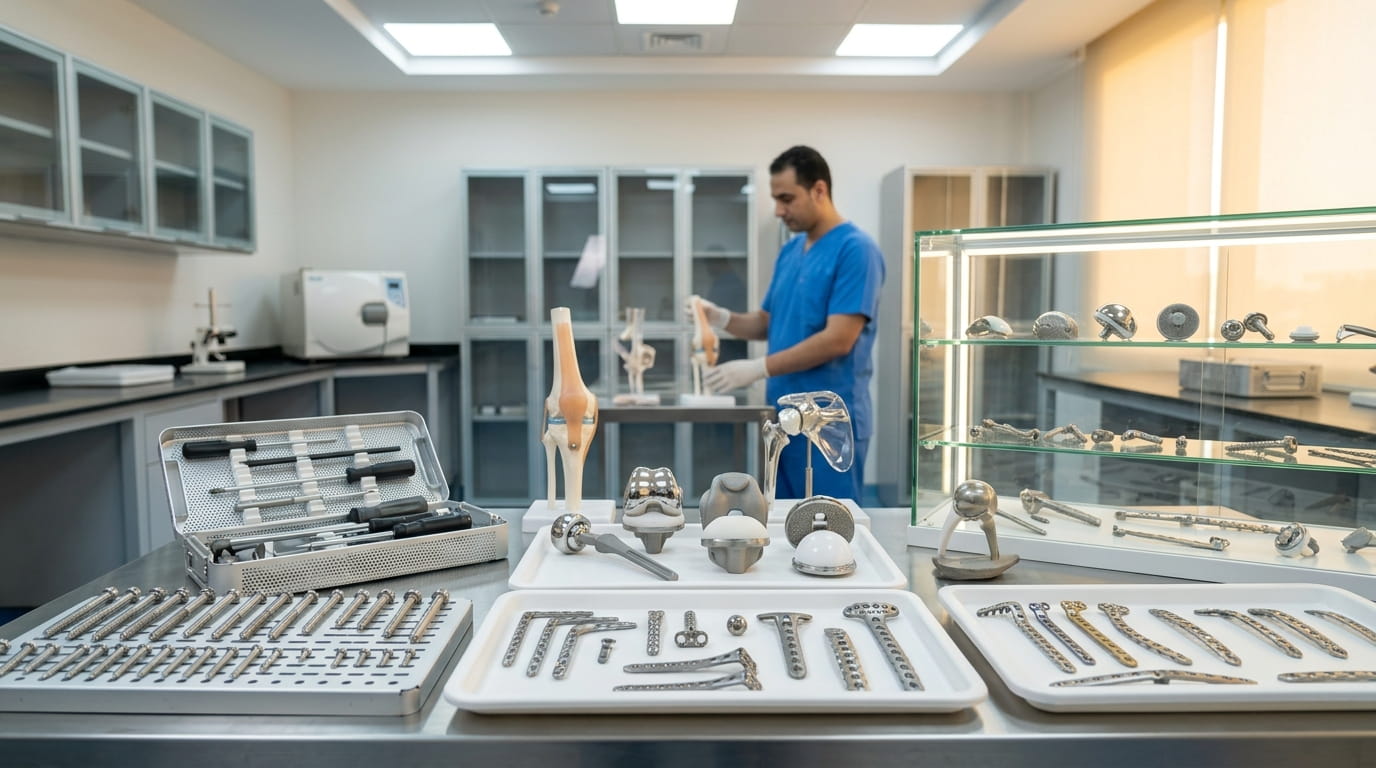
The second question should be operational support. Procurement should ask how core sizes will be defined, how stock levels will be monitored, how usage will be recorded, and how instruments will be prepared before surgery. These questions help determine whether the supplier can support long term hospital reliability.
Important procurement questions include:
- Which OrtoHip and OrtoKnee systems are included in the proposal
- Which implant sizes should be considered core stock
- How replenishment will be planned after usage
- Which instruments and trays are required for each pathway
- How lot information and traceability will be recorded
- How urgent requests will be handled
- How the hospital and supplier will review performance
Building supply continuity for hip and knee arthroplasty in Egypt
Supply continuity is one of the most important reasons Egyptian hospitals should choose a focused orthopedic implant supplier. A planned hip or knee surgery can be delayed if a required implant size, instrument, or trial component is missing. This creates operational pressure and weakens confidence in the supplier.
A strong supply model begins with expected case volume. The hospital and supplier should define which systems will be used, which sizes must remain available, and how replenishment will happen after each period of use. The goal is to reduce emergency purchasing and create predictable operating theatre support.
For Ortonom Medical, supply planning should be connected directly to the selected OrtoHip and OrtoKnee systems. Hospitals should understand how product availability will be maintained, how stock reviews will be organized, and how urgent requests will be escalated.
| Supply planning area | Hospital objective | Supplier response |
| Core size planning | Protect scheduled cases | Define minimum availability |
| Replenishment | Avoid repeated stock gaps | Use clear reorder routines |
| Urgent access | Support unexpected needs | Define escalation contacts |
| Documentation | Maintain governance | Record product and lot details |
| Review rhythm | Improve over time | Hold periodic stock and usage reviews |
Instrument readiness as a trust factor for Egyptian hospitals
In hip and knee arthroplasty, the implant is only one part of the surgical pathway. Instruments, trays, trials, and preparation routines are equally important. A hospital may have the implant in stock, but surgery can still be delayed if the instrument set is incomplete or not prepared correctly.
Egyptian hospitals evaluating an orthopedic implant supplier should therefore ask about instrument readiness from the beginning. The supplier should help clarify tray content, preparation routines, inspection points, and escalation procedures when items are missing or damaged.
Sterile services teams play a critical role in this process. They need clear instrument lists, organized trays, and practical guidance for preparation. When sterile services can prepare the system confidently, the operating theatre becomes more predictable and surgeons can focus on the procedure.
Documentation and traceability for hospital governance in Egypt
Documentation is central to orthopedic implant procurement. Hospitals need clear product references, lot information, usage records, and traceability processes. These details support patient records, inventory control, internal audits, and procurement accountability.
A strong hospital orthopedic supplier Egypt should make documentation practical. If records are too complicated, hospital teams may struggle to maintain consistency. If the process is simple and structured, procurement and clinical teams can use it more reliably.
For Ortonom Medical products, documentation should be connected to the selected OrtoHip and OrtoKnee systems. Egyptian hospitals should know which product family is being used, which components are included, and how usage will be recorded after surgery.
Hospital agreements instead of one time implant orders
A one time implant order may solve an immediate need, but it does not build a reliable orthopedic program. Egyptian hospitals that want stable hip and knee services need cooperation models that define product scope, stock planning, instrument preparation, documentation, training support, and review routines.
This is where Ortonom Medical can be positioned as more than a product supplier. The company can support hospitals with a focused arthroplasty portfolio and a structured approach to cooperation. The goal is to help hospitals move from isolated purchasing to predictable program development.
Hospital agreements should define the selected products, expected volume, replenishment process, instrument responsibilities, traceability model, and communication pathway. With these details in place, both the hospital and supplier can measure performance and improve the relationship over time.
Egypt as a strategic North Africa orthopedic hub
Egypt has strong strategic value for orthopedic implant partnerships in North Africa. A well structured hospital cooperation model in Egypt can also support wider regional credibility in Morocco, Algeria, Libya, and other African markets. This makes Egypt important not only as a single country target, but also as part of a broader regional growth plan.
At the same time, the article focus should remain on Egyptian hospitals. Search intent around orthopedic implant supplier Egypt is specific. Hospitals, distributors, and healthcare groups in Egypt want to see that their market needs are understood clearly, not treated as a generic Africa message.
Ortonom Medical can support this positioning by focusing on Egypt first, then connecting the discussion to wider African cooperation. This allows the content to strengthen the existing hip and knee implant manufacturer Egypt topic while also opening new search intent around supplier, distributor, prosthesis, and arthroplasty implant queries.
The keyword orthopedic implant supplier Egypt can work together with several related search terms. These terms should be used naturally in the article and connected through internal links where appropriate. This helps build a stronger Egypt focused content cluster.
Relevant supporting terms include hip and knee implant manufacturer Egypt, hip implant supplier Egypt, knee implant supplier Egypt, arthroplasty implants Egypt, hospital orthopedic supplier Egypt, orthopedic distributor Egypt, and hip and knee prosthesis Egypt.
These terms should not be forced into every paragraph. Instead, they should appear where they match the section. Product focused sections can support hip implant supplier Egypt and knee implant supplier Egypt. Procurement sections can support hospital orthopedic supplier Egypt. Partnership sections can support orthopedic distributor Egypt and arthroplasty implants Egypt.
Why Egyptian hospitals can consider Ortonom Medical
Egyptian hospitals evaluating orthopedic implant suppliers need clarity, focus, and continuity. Ortonom Medical offers a portfolio centered on hip and knee arthroplasty instead of a broad unrelated medical equipment catalog. This focus helps hospitals evaluate the company more directly for orthopedic programs.
The OrtoHip portfolio supports bipolar, total hip, and revision hip pathways. The OrtoKnee portfolio supports fixed, mobile, and revision knee pathways. Together, these systems allow hospitals to evaluate a structured arthroplasty cooperation model.
For hospitals in Egypt, the value of Ortonom Medical is not only product availability. The value is in helping build stable surgical programs through product clarity, stock planning, instrument readiness, documentation, traceability, and long term hospital cooperation.
Orthopedic implant supplier Egypt is an important keyword for hospitals and healthcare organizations searching for reliable hip and knee arthroplasty partners. The strongest supplier relationship is not built only on product availability. It is built on stable supply, prepared instruments, clear documentation, traceability, training support, and a long term hospital agreement model.
Ortonom Medical supports this need through OrtoHip Bipolar Hip System, OrtoHip K2 Revision Hip System, OrtoHip Total Hip System, OrtoKnee Fixed Knee System, OrtoKnee Revision Knee System, and OrtoKnee Mobile Knee System.
For Egyptian hospitals, orthopedic specialists, procurement teams, and healthcare groups, Ortonom Medical offers a focused pathway for hip and knee arthroplasty cooperation. The objective is to support reliable hospital programs, protect surgical continuity, and strengthen long term orthopedic implant partnerships in Egypt.