



Y Plate
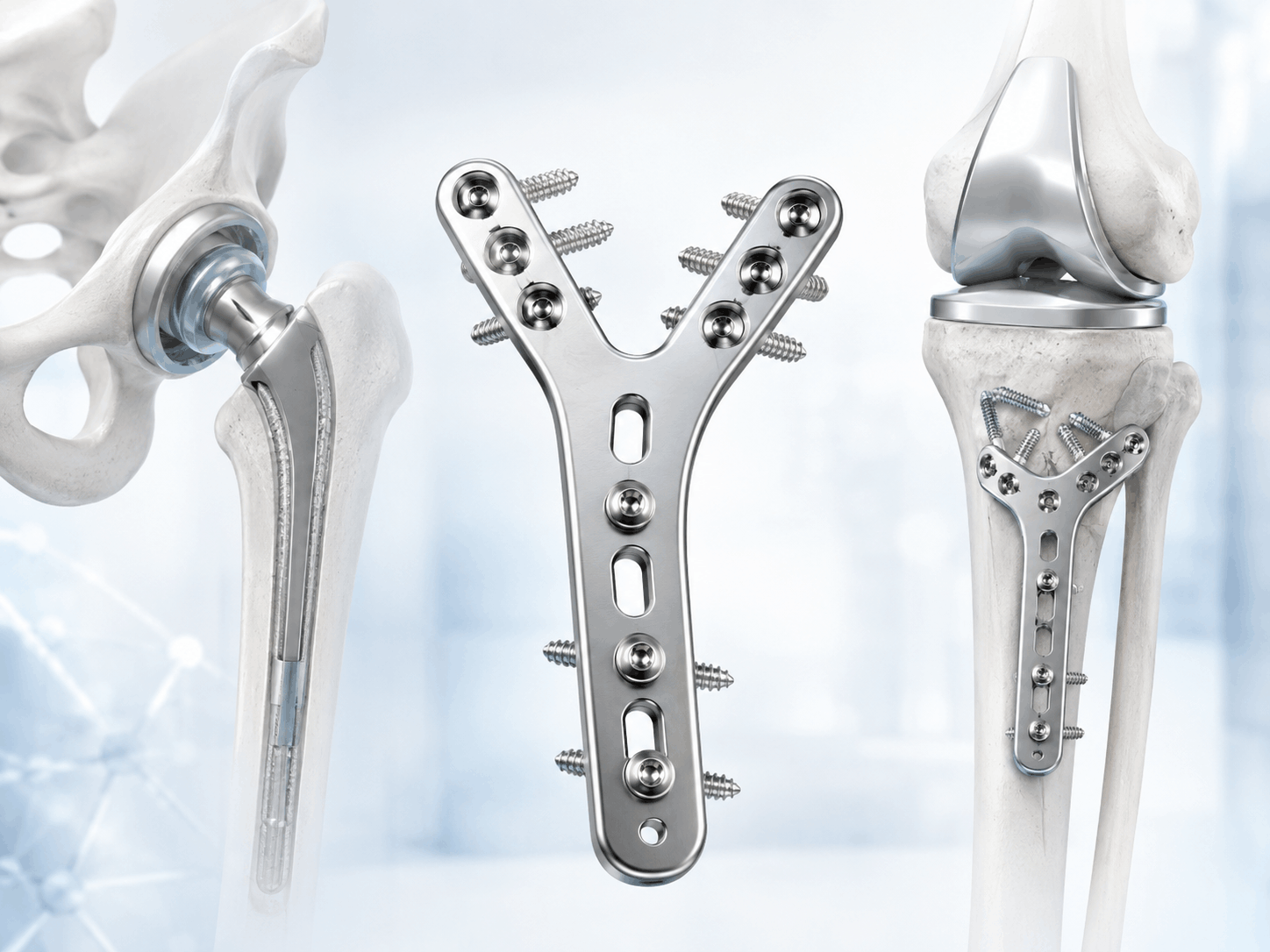
Y Plate is a specialized orthopedic fixation concept that may be considered in complex bone reconstruction and fracture management pathways. It should not be presented as a hip or knee prosthesis. Its relevance to arthroplasty appears when hospitals plan for complex fixation needs surrounding existing implants, revision procedures, or fractures that may occur near a prosthetic joint.
Y Plate planning requires more than selecting a plate from a catalog. Hospitals must evaluate the intended anatomical application, plate geometry, compatible screws, fixation strategy, instrumentation, and the relationship between the fixation construct and any existing implant. Without this coordinated evaluation, the risk of incomplete preparation increases.
Ortonom Medical focuses on hip and knee arthroplasty systems for African hospitals, orthopedic specialists, healthcare groups, and distribution partners. Within this focused portfolio, Y Plate discussions can be positioned as part of broader orthopedic readiness for complex cases while OrtoHip and OrtoKnee systems remain the foundation of the company’s arthroplasty offering.
Understanding the role of a Y Plate in orthopedic planning
A Y Plate is generally recognized by its branching plate geometry, which may allow fixation points to be distributed across more than one bone segment or anatomical direction. Its clinical relevance depends on the specific plate design, approved indication, and compatible fixation system. For this reason, the term should never be used as if every Y shaped plate serves the same purpose.
In hospitals with active hip and knee arthroplasty services, complex fixation needs may arise during revision planning, fracture management, or reconstruction around an existing implant. A Y Plate may become part of the discussion when the selected orthopedic strategy requires multidirectional fixation. The final use must always be determined according to the exact system and the surgeon’s clinical plan.
Procurement teams should therefore avoid treating Y Plate as a standalone generic product. The complete construct may include the primary plate, locking or nonlocking screws, connection components, dedicated drill guides, drivers, and other instruments. Each element must be confirmed before the hospital schedules the procedure.
Keeping fixation products separate from hip and knee prostheses
A Y Plate and a joint prosthesis perform different functions. A plate is generally used to support bone fixation, while a hip or knee prosthesis is used within a joint replacement pathway. Combining these categories without explanation can create an inaccurate product message and confuse hospital buyers.
Ortonom Medical’s core products are hip and knee arthroplasty systems. The fixation discussion should therefore support, rather than replace, the main arthroplasty narrative. Hospitals can evaluate OrtoHip and OrtoKnee systems for their primary and revision programs while separately assessing any fixation products required for complex cases.
This distinction is commercially important. African hospitals want suppliers and manufacturers that explain the scope of each product clearly. A focused and transparent presentation builds more confidence than suggesting that one product category can perform the role of another.
| Product category | Primary purpose | Hospital planning requirement |
|---|---|---|
| Y Plate fixation solution | Supports a defined bone fixation construct | Confirm anatomy compatibility screws and instruments |
| Hip prosthesis system | Supports bipolar total hip or revision pathways | Plan implants sizes instruments and surgical workflow |
| Knee prosthesis system | Supports fixed mobile or revision pathways | Plan components trays stock and clinical adoption |
| Revision system | Supports complex arthroplasty pathways | Align implants instruments and contingency planning |
Why African hospitals need complex case readiness
Hospitals expanding arthroplasty services must prepare for more than routine primary cases. As procedure volume grows, the institution may encounter revision requirements, difficult bone conditions, or fractures surrounding existing implants. Complex case readiness becomes part of the hospital’s long term orthopedic capability.
In South Africa Gauteng, Egypt, Morocco, Algeria, and Nigeria, high volume or premium hospital environments may place strong pressure on surgical scheduling. A complex case cannot be supported effectively when the required plate, screws, implants, or instruments are sourced only after the procedure has already been planned.
Hospitals in Kenya, Tanzania, Ghana, Senegal, Côte d’Ivoire, Cameroon, DRC, Gabon, Guinea, Libya, and Namibia also benefit from structured planning. Logistics can be more demanding in some markets, which makes early configuration review and realistic lead time management especially important.
Ortonom Medical hip systems within a complete hospital program
Ortonom Medical’s hip portfolio is designed to support focused hospital programs rather than unrelated general medical procurement. The range includes OrtoHip Bipolar Hip System, OrtoHip K2 Revision Hip System, and OrtoHip Total Hip System.
OrtoHip Bipolar Hip System supports hospitals that want a clearly defined bipolar hip pathway. OrtoHip Total Hip System is relevant to total hip arthroplasty programs that require coordinated implant and instrument planning. OrtoHip K2 Revision Hip System supports hospitals preparing for revision hip procedures and more demanding arthroplasty pathways.
These systems should remain clearly separated from Y Plate fixation solutions in the hospital proposal. The hip systems define the arthroplasty pathway, while a Y Plate may be considered as a supplementary fixation option when the specific orthopedic case requires it.
Ortonom Medical hip portfolio
- OrtoHip Bipolar Hip System
- OrtoHip K2 Revision Hip System
- OrtoHip Total Hip System
Ortonom Medical knee systems for primary and revision services
The Ortonom Medical knee portfolio includes OrtoKnee Fixed Knee System, OrtoKnee Revision Knee System, and OrtoKnee Mobile Knee System. These products allow hospitals to evaluate fixed, mobile, and revision knee pathways within one focused manufacturer relationship.
OrtoKnee Fixed Knee System can support structured primary knee programs. OrtoKnee Mobile Knee System offers another primary knee pathway, while OrtoKnee Revision Knee System is relevant when the hospital needs a defined strategy for revision procedures.
A Y Plate may enter the broader orthopedic discussion when additional fixation planning is necessary around the knee region or an existing implant. It should still be evaluated as a separate fixation construct with its own compatibility, documentation, and instrumentation requirements.
Ortonom Medical knee portfolio
- OrtoKnee Fixed Knee System
- OrtoKnee Revision Knee System
- OrtoKnee Mobile Knee System
Evaluating Y Plate compatibility before procurement
Compatibility is one of the most important issues in Y Plate procurement. A hospital cannot assume that a plate will work with any screw family, instrument set, or anatomical application. Every component must belong to the intended and approved system configuration.
The evaluation should begin with the exact orthopedic pathway. The hospital must identify the anatomical region, the presence of an existing implant, the expected fixation objective, and the system selected by the clinical team. Procurement can then confirm the correct plate variant, screw types, lengths, and instruments.
This process should be documented before the order is finalized. Written compatibility confirmation reduces the risk of mismatched products and incomplete instrument trays. It also gives the hospital a stronger basis for internal review and traceability.
| Compatibility question | Why it matters | Required action |
|---|---|---|
| Which anatomical region is involved | Y shaped plates may have different intended uses | Confirm the exact approved indication |
| Is an implant already present | Existing stems or components may limit screw placement | Review the complete fixation plan |
| Which screw family is compatible | Incorrect screws can make the construct unusable | Confirm type diameter and length range |
| Which instruments are required | Missing guides or drivers can delay the case | Verify the complete instrument checklist |
| Is an alternative configuration needed | Complex cases may change during planning | Define contingency options before surgery |
Instrument preparation for Y Plate procedures
Even when the plate and screws are available, the procedure can be delayed if the correct instruments are missing. Y Plate preparation may require specific drill guides, depth gauges, screwdrivers, bending or positioning instruments, and connection tools depending on the system.
Sterile services teams need a clear tray map. They should know which instruments belong together, how reusable items should be inspected, and how plate and screw compatibility is verified before sterilization. A generic instrument checklist is not sufficient for a complex fixation case.

The operating theatre team should complete a final readiness review before the scheduled procedure. This review should confirm the product configuration, sterile tray completeness, backup components, and escalation contact. A structured review protects the operating list and reduces last minute uncertainty.
Preoperative readiness checklist
- Confirm the exact Y Plate configuration
- Verify all compatible screw types and sizes
- Check dedicated drill guides and drivers
- Review reusable instrument condition
- Confirm sterile tray completeness
- Prepare backup fixation options where appropriate
- Document missing or damaged items
- Escalate discrepancies before the surgical date
Creating a supply model for complex fixation needs
Complex fixation products often require a different stock model from frequently used arthroplasty implants. Hospitals may not need high quantities of every Y Plate configuration, but they need a clear plan for essential products and urgent access.
The stock strategy should reflect procedure volume, local case patterns, hospital capability, and logistics lead times. A major orthopedic center in South Africa Gauteng or Egypt may require broader immediate availability, while another facility may use a planned case ordering model supported by predefined lead times.
African hospitals should also avoid overstocking low use configurations without a clear case forecast. The better approach is to define essential stock, available backup options, replenishment procedures, and an urgent request pathway.
| Stock control area | Hospital objective | Partnership requirement |
|---|---|---|
| Essential configuration list | Protect likely complex cases | Define minimum plate and screw availability |
| Case specific ordering | Avoid unnecessary inventory | Confirm needs before scheduling |
| Replenishment process | Restore used components quickly | Set clear ordering and delivery routines |
| Urgent access pathway | Support unexpected requirements | Define escalation contacts and response expectations |
| Packaging control | Protect product usability | Check integrity expiry and storage conditions |
Documentation and traceability for hospital governance
Documentation should identify every implanted component clearly. For a Y Plate construct, the hospital may need to record the plate, screws, connectors, and other associated products. Accurate documentation supports patient records, inventory reconciliation, and future review.
The commercial partner should provide organized product information, reference codes, lot details, and compatibility records. Hospitals should not have to reconstruct this information after the procedure. The documentation pathway must be agreed before implementation.
Multi site hospital groups require even greater consistency. The same forms, naming conventions, and traceability process should be used across facilities. Standardization allows leadership to compare inventory use and maintain stronger governance.
Regional partnership priorities across target African countries
Hospital agreements should reflect the practical needs of each region. In South Africa Gauteng and Namibia, rapid response and operating schedule protection may be central. Hospitals want visibility into stock and clear escalation when a complex case is planned.
In Morocco, Algeria, Egypt, and Libya, structured documentation, procurement compliance, and traceability may play a stronger role in approval. Manufacturers and distribution partners must present clear records and realistic delivery commitments.
Nigeria, Ghana, Senegal, Côte d’Ivoire, and Guinea offer opportunities for expanding orthopedic programs that need scalable product access. Kenya and Tanzania also require structured implementation as arthroplasty capacity grows. In Cameroon, DRC, and Gabon, dependable communication and logistics planning can strongly influence hospital confidence.
| Region | Target markets | Main agreement priority |
|---|---|---|
| Southern Africa | South Africa Gauteng and Namibia | Availability and rapid response |
| North Africa | Morocco Algeria Egypt and Libya | Documentation governance and traceability |
| West Africa | Nigeria Ghana Senegal Côte d’Ivoire and Guinea | Scalable supply and hospital growth |
| East Africa | Kenya and Tanzania | Program readiness and implementation |
| Central Africa | Cameroon DRC and Gabon | Logistics continuity and communication |
Developing hospital agreements beyond a single product order
A long term hospital agreement should not begin and end with one Y Plate order. The agreement should define the wider orthopedic scope, the arthroplasty systems being considered, fixation readiness, instrument responsibilities, documentation, and stock support.
For Ortonom Medical, the main commercial objective is to establish focused cooperation around hip and knee arthroplasty. OrtoHip and OrtoKnee products can form the central program, while complex fixation planning can support the hospital’s broader readiness.
This approach is more valuable to African hospitals because it creates continuity. The hospital gains a clear product structure, defined contacts, regular inventory review, and an escalation model instead of restarting the procurement process for every complex case.
From hospital inquiry to a structured proposal
A useful hospital inquiry must include more than the words Y Plate. The request should identify the intended anatomical area, clinical pathway, existing implant context, planned procedure date, and required instrument support.
The commercial team can then prepare a structured proposal that lists the plate configuration, screws, instruments, documentation, delivery plan, and responsibilities. This reduces the risk of incomplete quotations and unclear expectations.
The proposal should also identify whether the hospital is evaluating a broader hip or knee program. This creates an opportunity to discuss the complete Ortonom Medical portfolio and build a longer term hospital agreement instead of processing an isolated order.
Information hospitals should provide
- Intended anatomical application
- Existing implant or prosthesis context
- Planned fixation strategy
- Required Y Plate configuration
- Compatible screw requirements
- Instrument and tray needs
- Expected procedure date
- Hospital and delivery location
- Need for hip or knee revision products
Why focused cooperation builds confidence
Hospitals gain more value from a partner that understands the difference between arthroplasty and fixation. A focused orthopedic relationship allows products to be positioned accurately and prevents unsupported claims.
Ortonom Medical’s core strength remains its hip and knee portfolio. OrtoHip Bipolar Hip System, OrtoHip K2 Revision Hip System, OrtoHip Total Hip System, OrtoKnee Fixed Knee System, OrtoKnee Revision Knee System, and OrtoKnee Mobile Knee System support structured arthroplasty discussions.
Y Plate can be addressed as part of complex fixation readiness when the hospital’s clinical and operational plan requires it. This accurate positioning helps hospitals make informed decisions and strengthens the foundation for long term cooperation.
Y Plate is a fixation related concept that can be relevant to complex orthopedic planning around hip and knee arthroplasty services. It is not a hip or knee prosthesis and should not be presented as one. Its value depends on the exact anatomical indication, compatible plate system, screws, instruments, and surgical strategy.
African hospitals need partners that can manage these details through structured procurement, compatibility control, instrument readiness, traceability, and realistic supply planning. This is especially important across South Africa Gauteng, Morocco, Algeria, Egypt, Nigeria, Ghana, Kenya, Tanzania, Libya, Gabon, Senegal, Namibia, Cameroon, Guinea, DRC, and Côte d’Ivoire.
Ortonom Medical supports hospital cooperation through its focused OrtoHip and OrtoKnee portfolio. By combining clear arthroplasty pathways with disciplined complex case planning, hospitals can build stronger agreements that protect surgical continuity and support the long term development of orthopedic services.